About Me

My photo
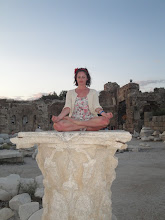
Namaste and welcome, I am a London based Vinyasa Flow Yoga Teacher dedicated to harnessing the ancient healing and transformative power of yoga, rooted in the Krishnamachrya lineage, for the rhythm of London life. Classes focus on connecting breath with movement in the art of vinyasa, creating a moving meditation which cultivates self-awareness, unity and realising our unlimited potential. In my dynamic, flowing and playful classes discover the beauty of just breathing, just being, delve into your heart space and connect with your inner spirit as we go deeper on the yogic path.

Annamaya; Kosas, Dhatus & the Subtle Casual Bodies

Discover Yoga Anatomy Day 2, Krishnamachrya Yoga Mandiram

The sessions today were a continuation of yesterday's focus on exploring the spine as central to yoga practise and philosophy. We carried on looking at the gross, physical level and during the course we will go inwards to the subtle and esoteric, although of course all these dimensions are intrinsically interlinked.

Yesterday we looked at how each element is represented in the body and today we attributed it to sections of the spine and to its function as follows. This relates to the chakras but we will explore this in further detail later.

Base of the Spine - Earth - Illimination

Lower Spine - Water - Reproduction

Naval Centre - Fire - Digestion

Chest/Heart - Air - Respiration

Throat - Space - Communication

Forehead - Sensory - Perception

Top of the head - Cognition

Pancha Maya

A key concept to the vedic view of the mind - body is the the 5 Mayas, dimensions/layers.sheaves which are fluid and affect each other:


Anamaya

The gross, physical body comes from food, we literally are what we eat, and then we join at this level we join the food cycle when we die. As we are starting from the outside we discussed ways in which we can define and understand Anamaya as follows:

Kosas

There are 6 kosa's (bags) which constitue the human body structure, its organs and its key functions

Svasa Kosa - Lungs/ Respiration - Nourishment

Annakosa - Stomach / Digestion - Nourishment

Mutra Kosa - Urinary Bladder - Elimination

Mala Kosa - Rectum - Elimination

Rajo Kosa - Uterus - Procreation

Viriya Kosa - Scrotum - Procreation

If the 3 primary functions, nourishment, elimination and procreation, are working correctly then we will be healthy. It is prana, life force, which provides energy for these actions.

Dhatus

From the Ayurvedic perspective the anamaya is summarised by the seven Dhatu's which is the essential structures and the various types of tissue which the human body is made of. The word Dhatu in Sanskrit means "that which forms the body". The root Dha means support and the Dhatus sustain the body. The transformation of Annam / food happens in every dhatu with the vital force of agni.

Rasa - Essential nutrition, the semi-fluid which is produced in the stomach through digestion

Rakta - Blood

Mamsa - Flesh, muscle tissue

Medas - Adipose, fat, responsible for lubrication

Asthi - Bone, provides strength to the body

Majji - Bone marrow and nerve cells

Sukra / Arthava - Reproductive fluids, semen in the male and the ovum in the female. A part of this dhatu transform itself into the ojas.

Ojas - Translated as immunity, energy, vigour and is an abstract entity with no equivalent in modern medicine. It is the interface between the spiritual and material dimensions.

Subtle / casual bodies

There are metaphysic ideas such as karma which relate to yogic philosophy as follows:

Karma An action done today will affect how we are reborn the future lives.

Sarira
A concept we have to accept within our investigation is that of the Sarira's which can be described as
a body or vehicle which is impermanent and through which an ethereal entity lives and works.

Sthul SariraGross body at the physical plane. At the moment of death the soul leaves the physical body.

Suksma Sarira
Subtle astral body, pranamaya, manomaya, vijnamaya

The sould carries impressions from past lives which affect new life. For example a supremely talented musician may not be attributed to genetics but to skills mastered in past lives. Thoughts and beliefs also shaped by past experiences.

Karana Sarira
Causal, mental and bliss body.

There are many concepts which are new to me here but I am sure as the course progresses I will grasp a better understanding of the relevance of these ideas. For now I am as amazed as ever at how these ancient wisdoms defined such complex understandings of the planes of human existence!


Interpretation of Pantajali's Yoga Sutras

III 21 Kaya rupa saroyamat tad gratya sakti stamble caksuh prakasa asamprayage antardhanam

When you reflect on the body and its form you can become invisible.

This sutra is about removing identification in the physical body and shedding the ego until you become invisible, without the ego there is nothing to see. By reflecting on body and travelling inwards through the practise of yoga your mind is in a state of clarity, you become very clear about your qualities and no longer seek reassurance from others. You accept both the good and bad and can just be.

To transcend form need to go beyond the Tanmatras, the five senses, which is how we perceive the external world.


Shabda - Sound

Sparsa - Touch

Rupa - Form

Rasa - Taste

Gandha - smell


Kaya akasayah sambarolo samyama agnithimla sampattesca akasaga mama

When you reflect deeply on the link between space and body you become light and weightless.

In a literal sense this can relate to the siddhi/power of levatation however this is not accessible to most of us and more relevantly we can attribute this to the lightness of the mind which happens in the sattwic state. When we move inwards through the dimensions of the Maya's we get lighter and lighter until we reach pure soul, Atman. In this light, blissful state you can float through life and problems can not weigh you down.

We can relate these moving inwards and reflection to moving through the Bhutas which in themselves each have negative and positive attributes:

Prithi - Earth - Tamas - Relates to the Kleshas which are the obstructions which hold you back and weigh you down. On a positive side Prithi provides stability and grounding.

Water - Relates to the senses which are constantly moving and go everywhere as well as cleansing and purification.

Agni - Fire - Desire and digestion, elimination of what doesn't serve you

Vayu - Wind - Relates to Abhinevesa/ fear.

Akasa - Space - When we have moved through the elements we then have the space to change and evolve.

Application of Yogic Anatomy - Classification of the Postures

In this session we continued looking at how the ancient masters, sages and rishis classified the asanas with the central focus on the movement of the spine. Yesterday we looked at Purvatana postures which is an expansion of the East/ front/anterior of the body and today we looked at those which extend the back.

Pascimutana

Pasci - transalated as West and so relates to the back of the spine / posterior

Tana - means Stretch

Pascimutana poses work on extending and lengthening the back of the spine to enable the chakras to be aligned and prana to flow. For example Paschimottanasana, Uttanasana, Padhastasana, Prasarita Paddutanasana, Adho Mukha Svanasana, Apanasana.

To help lengthen the spine we use Stithi in many of these postures where by after exhaling into the posture we take an inhale and stretch the spine further before exhaling to deepen the posture.

Purvatana postures are done on an inhalation and the basic idea of the posture is nourishment.

Pascimanata postures are executed on an exhalation and they relate to elimination. These posture reduce toxins, by sending what we don't need to the naval to get burnt.

Yogic Anatomy - Modifications and Therapeutic Applications
In this session we observed the spine, which is best done when person is standing in tadasana with feet together, and how you could offer modications and develop a personalised practise for someone with misalignment.

Kyphosis
Rounding of the shoulders, restricted breathing as the ribcage can't fully expand and kneck restricted. If it is severe than start with subtle movements which open up restricted areas such as standing in tadasana and inhaling arms up above the head and down, then using a wall to one arm at a time reaching up and back to begin chest opening or modified half forward bend using a table for support.

Lordosis
Excess curvature in the lower spine which causes back pain, weight of the body to be off balance and the pelvis misaligned. It is best to begin with seated forward bends as the hips are grounded and support and pelvis stabilised. Also work on core strength to support the lower back.

Scoliosis
Lateral deviation of the spine which can be identified by the hips or shoulders being not level, one leg may be longer than the other and when someone is lying down the ribcage may show different levels of elevation. When you have pinpointed how the spine is deiviated than can prescribe lateral movements such as standing up and leaning to one side - do twice on the side which needs balancing and once on the other

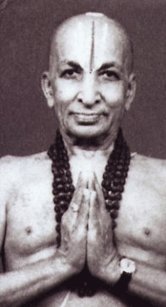
Krishnamachrya Yoga Mandiram "Discover Yogic Anatomy" Day 1

I am back in beloved India and it feels great! I'm bursting with ideas after my first day studying at Krishnamachrya Yoga Mandiram, Chennai.  I am really glad I decided to join the course and go directly to the root of the teachings inspired by the great guru of modern yoga, the teacher of teachers Krishnamachrya and his equally brilliant son Desikachar who has mastered the therapeutic application of yoga. 


It's only day one and we've already explored soo much which I want to share with you all. Here's a run day down of the daily schedule:

07.00 - 08.15 ASANA PRACTICE

The practise consisted of exercises taken from Desikachar's Heart of Yoga which are repetitive simple vinyasas (breath linking movement). Doing this type of practise highlights that sometimes by taking things away you can gain greater level of attention, the beauty of simplicity. For example when we take the opening postures from surya namaskar (sun salutation) on it's own (inhaling the arms above the head, exhaling hands to earth in uttanasana, inhale extend the spine look out in ardha uttanasana) seperate from the full sequence we really refine the movement and aknowledge the details of each asana in its own right.

09.00 - 09.50 YOGIC ANATOMY

I found this session particularly mind-blowing, it connect many dots and helped me comprehend the yogic philosophies inherent in Hindu cosmology and to appreciate the relevance. Some very complex ideology by will try put into words...

As I had wriiten about in my previous post in yogic philosophy there is the concept of supreme, universal consciousness, Purusa, in sanskrit. It's primordial, we can't intellectualise it we must accept it, it is:

SAT - It is /Absolute

CIT - Consciousness

JNANA - Wisdom

ANANDA - Bliss

ANANTA - Endless / Beyond All

NIRGUNA - Changeless

On the micro cosmic level there is Prakti which is the source of all creation, fundamental material matrix and an interplay of the three Guna's (matter/quality/attribute) - Sattva (lucidity, light, clarity), Rajas (movement) and Tamas (heaviness, inertia). Prakti is tangible to us because we can feel it through the body, mind and senses.

In our understanding we want to or don't have an option but to start from the gross level, Prakti, and then we have to accept the subtle, Purasa, as it is beyond intellectual comprehension.

The elements that exists in the universe on a macro level are present in the body on a micro levelas follows. The moon and the sun are also represented in the body.

BRAHMAN / PURUSA - Supreme Consciousness

AKASA - Space / Ether

VAYU - Wind / Prana

AGNI - Fire

ABA - Water

PRITHI - Earth

OSADH - Plant /Herbs

AMAM - Food

PINDA - Human

PURUSA - Human soul embodied

These elements go from the most subtle down to the gross, from those that we can't see to those that we can see, touch, smell and taste.

Purusa exists in us, it is embodied in the soul. Yoga happens when Purusa on our inner soul, micro level unites with Purusa on the sumpreme conscious universal macro level.

How do we access the Cosmos?

We access the cosmos through the structure of 14 realms (sun, moon, mountains to be much to fully go into here..) for example Meru which is translated as mountain. Meru is reflected in the body as the spine. The Ancient masters, who predate modern medicine by 2,000 years, that the spine is at the centre of the body and the way to access higher consciosness. In sanskrit the spine is Merudanda, translated as 'mountain stick'. When we are thinking of the spine we are considering it from an esoteric, energitical perspective rather than the bones and muscles. The key chakras (energy centres) and nadi's (subtle channels of energy) are loacated. 

By enquiring into this we get closer to the perfect nature, we no longer percieve ourselves as just the gross body and we move to our highest potential.

Churning of the Milky Ocean (the good / bad cycle)

In this story from Hindu cosmology there is a mountain, Meru, which stands in the milky ocean, on one side there are the Gods and on the other the Demons. Both good and bad sides want to release the nectar from the mountain and to do this they churn the ocean. Each side needs the help of the other to make this happen but the problem is the churn keeps slipping and they need help. They pray to Vishnu, the God of preservation, who goes under the mountain to give support and enables the nectar to be realised. In another adaptation they call on Shiva who consumes the poison so everyone is safe and can enjoy the nectar.


This story is interesting from a yoga perspective because we have both good and bad within us. We have to start from the stability of the spine which relates to meru / the mountain. Yoga is the process of churning, refining oneself to acquire extraordinary power, the nectar/the siddhis, which are released by the ocean. The ocean is the mind, it is constantly moving but when this ceases and there is stillness this is when nectar is released.

In this process of transformation not just nectar but also toxins are released. Therefore we need Shiva / the teacher to guide us through the process. Shiva keeps the poison in his throat which turns blue. He doesn't absorn any of the poison and he doesn't release it, like an excellent teacher he is not affected by others problems and doesn't share, respects confidentiality.

It's hard to summarise but basically everything in yoga is to transcend the confines of our physical form to Purusa, supreme, universal consciousness, union and this journey is beautifully woven into Hindu stories.

All this in just one 50 minute lecture, needless to stay I can't wait for the rest of these tutorials!

10.00 - 10.50 APPLICATIONS OF TOOLS OF YOGA BASED ON YOGIC ANATOMY

Continuing from the previous class we focused on the spine and how we can make it stronger through the asana. Before doing any postures we stand or sit upright and observe oneself and the breath. This position is called Sama Stithi and can be done standing in tadasana, sitting dandasana or lying savasana and it works to balance the body and mind, right, left, front and back in equilibrium and works as a reference point from which to begin and return to.

Breathing helps to calm the churning of the ocean, the mind, to bring greater consciousness to the practise. Working on the physical spinal alignment, aligns the chakras and strengthens the internal structure.

Next we looked more deeply at how the asanas are traditionally classified in sansrkit by the ancient masters and what this tells us about the postures. We began with the Purvatana (translated to 'east stretch') postures which are traditionally done facing east to the rising sun. These postures are an expansion of the front of the body, the anterior. These postures are done an inhale as it is an upwards expansion of the chest.

Purvatana postures include the following where the front of the body lengthens and the anahata (heart) and vishuddhi (throat) chakra open: Virabhadrasana I (Warrior I), Dhanurasana (Bow), Purvatanasana, Ustrasana (camel), Urdha Dhanurasana (wheel), Ardha Utkatasana (Chair) etc.

Therefore these postures that we typically think of as being backbends when instead the focus is on expanding the front of the body. I was aware of this thanks to Claire Missingham's extremely wonderful teaching but its good to bring it to forefront of the attention by putting it in conext of the sanskrit translation.

11.00 - 11.50 ASANA & PRANAYAMA PRACTICE

14.00 - 14.50 YOGIC ANATOMY IN CLASSICAL TEXTS

We spent this session in an open discussion and interpretation of Pantajali's Sutra III 47:

Svadhyaya Rupa Lavanya Bala Vajna Which roughly means when you reflect on the body it has strength of a diamond.

Most of the time we suffer because we stay in one dimension, we don't like change. But when we reflect and are able to move easily through the five dimensions of the body, Panca Maya, we can accept changes. When you accept you become strong and resilient to the stresses of life and the pure, natural, diamond shines forth.

15.00 - 15.5O APPLICATION OF TOOLS OF YOGA BASED ON YOGIC ANATOMY II

This session explores modifying postures and the therapeutic implications and affects of asana. The form of an asana is unique for everybody as we are all structually different and the fuction of a posture is also different depending on the person. Asanas are modified for injury, illness, age, pregnancy etc as well as to create a new awareness to a posture and prevent it becoming routine for a regular practioner.

Not only can we modify a posture on a physical level but also by introducing new breathing patterns which creates a different focus and experience eg: Inhale for 6 and exhale for 6 to inhale for 6 and exhale for 12.

We broke down ways of observing the body on a superfical level by the key reference points:

Spine

Tip of the nose (is it jutted forward or inline)

Shoulders (are they level? check whilst standing, ideally against a wall)

Naval/centre

Hips (when lying down relaxed, look at the feet to see if they are even when they roll open or if one opens more than other and if one leg is longer than the other)

It is important that when you make these observations that both you and the person are relaxed and that you check a number of alignment points in different positions to clarify any imbalances.

16.10 - 17.00 MANTRA & MEDITATIVE PRACTICE

In the closing practise of the day we incorporated the modifications of the breath in a vinyasa moving from balasana (childs pose) to cow pose as follows:

INHALE EXHALE

2 4

3 6

4 8

In the first round we focused on the lower half of the spine whilst doing 4 rounds each of the breathing patterns above. Next bringing attention to the centre of the spine and repeating same breathing sequence and then again with the attention at the top section of the spine.

Then we sat in ardha padmasana and repeated the breathing as above and keeping the attention at the heart on the inhalation and at the naval on exhalation to prepare for meditation.

When the spine is strong we can support ourselves to sit comfortably for meditation with the spine aligned and completely still. When the spine is still, the mind is still. Asanas are designed to prepare and strengthen the spine by bending forwards and backwards and revolving and twisting.

Wow all this from just the first day and I am sure many more jigaw pieces will slot together and pictures become clear over the next 2 weeks!

Meditation & the Collective Consciousness

Like most people my interest in yoga began routed in the physical, the asanas, and although this is still an integral part of my daily practise I am now following all the practises and philospohies as outlined by the eight limbs Patanjali's Yoga Sutras:

Yama
Universal morality

Niyama Personal observances

Asanas Body postures

Pranayama Breathing exercises, and control of prana

Pratyahara Control of the senses

Dharana Concentration and cultivating inner perceptual awareness

Dhyana Devotion, Meditation on the Divine

Samadhi Union with the Divine

In very simplified terms the physical practise is a way of preparing the body for the breathing practises/pranayama which in turn help us to take control of our senses (see Power of Pranayama post here for further information), leading to deeper concentration and awareness and over time towards Dhyana and eventually Samadhi.

Practise of the asanas feels great, we hold many of lifes stresses within the body itself and so opening and moving releases these tensions and allows prana/energy to move more freely. It is intself a technique of moving meditation whereby we connect to the present, focus on the flow of the breath and the sensations in the body. On a practical level it literally prepares the body to be able to sit still in a comfortable (crossed legged then working eventually towards full lotus/padmasana) position with the spine erect and sushumna (the central channel) in alignment for meditation.

I am currently blessed with more free time to do what I love and so this has enabled my meditation practise to blossom. In London I tended to only be able to meditate for upto 20 minutes and I didn't have a consistant practise. Now, with the techniques I have learnt (see Introduction to Buddhist Meditation here and check out Alessandra Peceorella's Shabda CD here) I find it much easier to meditate for longer periods on regular basis and those moments of complete blissful silence are increasing.


The numerous benefits of meditation I am enjoying include greater

Clarity

Connection

Contentment

Compassion

Consciousness


There is an incredible wealth of scientific proof that meditation improves your health and actually affects those around you. If you don't meditate yet than I urge you to give it a go, even just starting with 5 minutes a day you will feel the benefits and be contributing to the higher consciousness.

Why and how can meditation make you happier?
In meditation we remove the layers of our rigid perceptions of who we are and the stresses and anxieties that this perception can hold and delve deep to the core of our Being.

In this state of Being (our true nature, the source, the eternal self) consciousness is no longer seperate and we enter a state of unity (a translation of the sanskrit word yoga is to unite) on a universal level.

Thousands of years ago the Vedas described Being as sat chit ananda /eternal bliss-consciousness and outlined the route to this state as through meditation. Contentment is within us, the most natural state is to be happy. Meditation evokes deep happinesss which makes you healthier as it systematically reduces stress from the nervous system.

During meditation you are contributing to the higher, collective human consciousness because your state of sattwa (purity) actually brings peace to your wider surroundings and the larger community.

In the words of Deepak Chopra

"The explanation offered by the rishis is simple: human consciousness is a whole, a single awareness that at a deeper level is shared by all. This collective consciousness unites people at their source, and whatever is generated from there is accepted as reality. When the collective conscious is weak and in conflict, negative trends predominate in society: there is crime, war, and absence of knowledge about enlightenment. by the same token, if collective consciousness can be made positive, these trends will decrease. It is just a matter of injecting a harmonious influence at the appropriate level, and everyone will feel the benefits."
(Return of the Rishi p170)

And for all the sceptics out there who this has all sounded like mumbo jumbo so far here's just a couple of examples of the scientific studies which have proved meditation's power to create peace:

"A Transcendental Meditation teacher whose parents lived in Lebanon feared for their safety. Their small village of Baskinta was in the war area under the most devastating bombardment from both sides. The surrounding mountains had been heavily armed with cannons during the past several years. TM's theory of collective consciousness held that if 1 percent of the people in the village meditated, they would not have to fear any enemy. So the teacher went home to Lebanon and taught TM to 1 percent of villagers. Then he followed what happended to them. In the next six years the bombing increased and the whole area was demolished. Casualties and damage were horrendous. Not a single bomb fell on this village. One day a single shell hit a tree. Nothing was damaged and noone was hurt."

"During the Christmas holiday in 1983, enough meditators gathered in Fairfield, Iowa, to reach the number needed for a global effect, about seven thousand, They meditated together for two weeks to create strong waves of coherence in world consciousness and then left. During exactly that periodm, crime rates decreased in other countries, international hostilities cooled down, and even the stock markets rose on a global scale. The trends reversed when the assembly dispersed."
(Return of the Rishi, Deepak Chopra)

I'd love to hear any of your experiences of meditation and if you have any tips on incorporating a meditation practise into your daily life....

Living On Purpose & Dreaming Big

Whilst travelling in Asia I have always aimed to follow my higher purpose, my Sadhana, a conscious spiritual, meditation and yoga practise. Some places have heightened my practise and I have never felt more aligned and focused (namely North India). While others it has been harder to find the space and energy to dedicate as much time as I would like because I was also relishing in new experiences such as diving, trekking, historical museums, socialising and travelling in itself.

Recently I have found it challenging that the majority of people I meet and am surrounded with have very different intentions. Many people use the opportunity to travel as an excuse for one massive indulgent booze filled party. I don't want to judge others but I personally don't want to waste my time in some of the most amazing places in the world being off my head or suffering from an excrutiating hangover. Of course I like to have a good time and let my hair down now and then but not night after night, day after day until it's one big blur - I've had enough of that in my early twenties.

But anyway I digress my point is that although I know I don't want to drink loads and party hard it can be difficult to obstain when everyone around you is and say they are having the 'time of their life' and making lots of new 'best' friends. When I was struggling with this feeling the other night I was lucky enough to get talking to Jacob Sokol. It's amazing how one conversation with a like minded person is sometimes all you need to validate your opinion and strengthen your resolve to stick on your path even if its veering off in different direction to the majority. Even though they are often just acting as a mirror to the truths which already inside.

Jacob is a really insipirational person. When he was suffering from disillusionment and was discontented in his early 20's when he should have been happy as he suppossedly had it all (I know this feeling all too well), he undertook a radical change to create an 'extraordinary life'. Jacob confronted his unhappiness and decided to leave his old life behind; quitting his brilliant job in NY Times Square, selling his car and setting off on a mission to retrain and study everything that interested him in order to create a life he loved. Better still he chartered his personal journey with an incredibly honest blog which attracted huge numbers of followers (eg this post
www.sensophy.com/14-monumental-moments-of-2010/).

Two years later Jacob is using what he learnt to help others, sharing his stories with hundreds of thouasands of people who follow his super successful website: www.sensophy.com, he has written a book Living On Purpose and is working as a personal life coach. And if that wasn't exciting enough he is doing all of this whilst embarking on his latest adventure spending time in cool places across the world - San Diego, Tokyo and currently Chiang Mai. It was really exciting to see how much Jacob has achieved in a relatively short space of time by focusing wholeheartedly on his purpose.

It's time for me to do the same, I know my path and I have the perfect opportunity to build a successful life around it. I am returning to beloved India in a few days time to completely immerse myself into living my purpose, my spiritual sadhana and commitment to the yoga and sharing it with others. No doubts, no resistance to change, no fear, I resolve to stay connected, true to myself and the gift of yoga and bring all of this back to London!

So in true Jacob style I'm dreaming big and aiming high, the next 3 months I will devote to:

      Immerse fully and completely in Sadhana in India  
      *  Learn the basics of ayurvedic massage
      Undertake a meditation retreat  Create a series of 12 themed, intermeditate 1hr30 vinyasa flow classes Plan a creative workshop in honour of Shiva and    Naturajasana        Keep writing and updating this blog with all my learnings   Read anything and everything that inspires me       Keep sharing
        And in the next 3 years my aspirations are to *  Devoted full time to teaching yoga (including regular workshops and retreats) and continuing my studies Offer atleast 15% off my funds/time to good causes including offering subsidised yoga to those that can't typically afford it and would benefit from it Have a professional website with rich content including video talks/demonstrations and a regular e-newsletter   *  Develop my writing in order to contribute to yoga publications/reach wider community Live an eco-friendly and ethical lifestyle        Keep sharing

Check out Jacob's website www.sensophy.com
for inspiration and sign up for regular newsletters

Creative Intuition: Letting go and breaking the rules

I'm currently enjoying chilling in Chiang Mai in North Thailand, it is a great city, firstly because it doesn't feel like a city even though it is the countries second biggest after Bangkok. Nearly every street has a beautiful, golden Buddhist temple and oranged robbed monks stroll contentedly. Thai food is one of my favourite cuisines and Chiang Mai without doubt has the the most delicious variety of vegetarian, organic Thai food and cool cafes serving an amazing array of fruit shakes. Chiang Mai has a really international community, with many expats chosing to work from here or use it as a base part of the year and not suprising as it's extremely cheap for a good quality of life (dorm room less than £2 per night, Thai meal from 50p).
If that wasn't enough Chiang Mai also has a great yoga community attracting excellent international teachers and offering an astonishing array of types of yoga rivalling London. Having only been to a a handful of yoga classes in the last two and half months I was glad to have the opportunity to attend a good class as a change from my self practice.

I was very happy when arrived at Wild Rose Yoga, its a beautiful wooden, intimate shala and I attended a workshop called Intuitive Flow Yoga with Christophe Cappon. Christophe explained that the session would be very different to a regular class as rather than him teaching and leading us through the practise it would be a session for each of us to intuitively experiment within parameters and guidance he would provide. The aim is to break our habbits and try new things.

Christophe encouraged us to ignore the regular rules of our practise, it doesn't matter if you don't do the same thing on both sides, it's ok to go into a pose which isn't a traditional posture, don't be confined to the mat explore the space, get lost in the movement, get creative and be guided by intuition. I had previously considered my practise to be creative as it is always different and ever evolving, I experiment with music and work on different focuses but I realised that actually I am very controlled and disciplined at sticking to the rules and never just let myself fully go and just enjoy pure movement on the mat.

I typically have an idea where a kramic sequence is leading and am very attentive to the number of breaths on each side etc which is very important when planning and teaching a class. However I had forgotten that's it's ok to sometimes just put on a song you love and dance on the mat, to be playful and try new things, to push to edge and fall and to explore movement beyond the asanas.

The next day I attended another of Christophe's classes, this time it was a more traditionally led class but continued from the previous workshop focusing on Change. Christophe challenged us to do things differently. For example rather than going into the adho mukha svanasana/downward facing dog pose we know so well and love really back off and finely attune the connection to the core, taking the gaze forward and keeping the shoulders strong rather than allowing them to open and roll down the back.

Here's some tips to get creative in your yoga self practice:

Freedom from your yoga mat
Don't be confined to your mat during the practise but move off it acknowledging how different surfaces feel and don't be limited to practising to the 'front' of your mat but move around and face any angle. Or why not ditch the mat altogether.

Practise outside
If you always practise in the same space at the same time, try somewhere new. Why not do it in the garden or local park? If you are worried about people looking and thinking you're strange then challenge yourself to tune in and focus on practise anywhere and enjoy sense of liberation this creates.

Turn up the music and rock out
Choose a favourite song which is as far away from your typical yoga music as possible, turn up the volume and move. For example it can be fun to use duration of one song to explore urdva dhanurasana/full wheel by pulsing in time with the music, lifting one foot then the other on to tiptoes and trying transitions into and out through wild thing etc...

Try new postures and alter the old
Choose a focus in the body such as the hips and just move intuitively to open this area, circling the hips and spiralling the legs without any concern about forming a traditional yoga posture. When you come into a familair posture such as agnistambasana/double pidgeon then change it by adding a twist or choose a different focus in a pose for example find the subtle heart opening in a forward bend. Or change the stance of postures, making them shorter or longer and acknowledge the differences.

Push the edge and fall
I'm not asking you to fall really hard and hurt yourself but it is good to sometimes go beyond our edge. Don't be scared to try that impossibly challenging arm balance even if you end up flat on your face. There is something in that moment of falling which is actually really freeing, it takes us back to being a child, it's humbling and stops are ego taking control of practise.

If this all fails to mix things up then get a radical new haircut!

http://christophecappon.com/

http://www.wildroseyoga.org/

Happy Maha Shivarati Yogis

Maha Shivarati 'the great night of Shiva' is a celebration observed by Hindus, particularly Shaivites who are dedicated devotees to Lord Shiva. Each new moon is dedicated to Shiva but this specific festival falls on the 13th night/14th day during the dark waning moon of the month of Maagha or Phalguna in the Hindu calendar and this year on Monday 20th February. The celebration marks the night Shiva, the revered Lord of the Yogis and there is great tales of Hindu mythology attached to the festival.

A popular legend is that is the wedding day Shiva and Goddess Parvati, in the eternal union of Shiva and Shakti and when Shiva revealed himself as Lord of the Dance Nataraja performing the Tandava; the cosmic dance of the cycle of creation, preservation and primordial conception.


The celebrations include offerings to Lord Shiva, worship and ritual bathing of the phallic symbol Shiva Lingam, fasting for duration of day and night and staying up all night keeping vigil while chanting devotional mantras. Shivrati is considered especially auspicious for women, with married women praying for the good health and fortune for their husbands and sons and single women praying for a partner who embodies the characteristics of Shiva (yes please!). It is believed that when you utter the name of Shiva during this special time with pure devotion then you will be freed from all sins and will be rewarded with divine bliss, samadhi.

I would have loved to have been back in India to experience the festival but I am in Borneo for the last leg of trip before I return to India to settle into deeper studies. For the night of Maha Shivarati I will be attempting to climb and summit South East Asia's highest mountain Mount Kinabalu. Although I won't be able to honour a fast as I need all the energy I can get I will use the trek as an act of pilgrimage as I will be trekking through the night chanting the sacred mantra Om Namah Shivaya.

I have always fond something magical about staying up all night and watching the sunrise, like a dawning of a new perspective and higher consciousness which comes from preventing yourself from sleeping/losing consciousness. At the top I will meditate as the sunrises offering my practise in honour of the great Lord Shiva.

Shivohum

I that am Shiva

Shivohum

Shiva I am

Shivohum

I am that which prevails everywhere, complete in itself. I am Shiva; the deity of eternal bliss


An Introduction to Buddhist Meditation with Jina

Whilst in Unawutuna in Sri Lanka (which is probably one of the most naturally beautiful countries I have had the joy to visit; encompassing extraordinary mountain panoramas, lush green vistas of tea plantations, stunningly pristine beaches, ancient Buddhist temples and wonderful friendly people to add the cherry on the cake!) I had the very good fortune to meet Jina. Adam's auntie who had worked in Sri Lanka became close friends with Jina and recommended us to visit him. He also happens to be from our neck of the woods having worked in a restuarant in Croydon (the world is never as big as it seems) before moving to Sri Lanka.


I was also excited because Jina runs a renowned vegetarian restaurant - Jinas Vegetarian and Vegan Restaurant - and I had found disappointingly slim pickings for veggies in Sri Lanka and so was looking forward to being catered for. And I wasn't dissapointed, Jina's restaurant is set in a beautiful, peaceful spot and offers my idea of food heaven; homemade bread and tzaziki, avocado salad, veg moussaka, vegan sugar free carrot cake and yummy yogi tea...the list goes on! Jina really creates food from the heart and soul and cooks with a Buddhist Zen approach.


But even better than the food is Jina's presence and his generousity to kindly offer an introduction to his Buddhist meditation practises with me.

Meditation on the Breath for the Rationale Mind

In our first session Jinas guides me through a meditation preparation exercise which focuses on developing the rationale, logic mind. The practise revolves around observing the breath, using the natural breath and not changing it in anyway, just watching the inhale and exhale. In the first part of the exercise count the breath at the end of each breath in a cycle up to ten breaths and then repeat over and over again. Then move on to counting the breath at the beginning of each breath cycle up to ten and repeating over and over again.

The next stage is counting the breath to ten in reptitive cycles while keeping the attention on the nose, feeling the sensation of the breath. Observing the cool air coming in and the warm air exhaling out. In the final stage let go of counting and purely observe the full breath, noting the begining, the belly rising, the progress of the breath, the pause and space at the end of the inhalation and then the belly sinking as exhaling and the end of the breath. There is no thought involved instead paying full attention to every physical sensation and detail of breathing. This then, eventually, leads into coming into pure stillness and just observing and letting go of any thoughts that arise.

The second session Jina leads me through meditation for compassion which works from the heart. He explains that it is important to balance both the heart and mind.

Compassion Meditation for the Heart

The practise begins by devoting love and compassion to yourself by directing energy inwards and using offerings such as;
May I be free from suffering
May I be healthy
May I be happy
May I be free from limiting beliefs
May I be kind
May I be peaceful
May I be inspired
May I be generous
May I be eternally grateful
May I be compassionate
May I be a source of light to those around me


The next step is to call to mind a close family member or best friend and send them offerings in the same way. Then extend this offering to a neutral person; someone you do not know soo well, an acquitance, someone you have lost touch with or see often but never really connected with. Next share with an 'enemy', someone you are not on best of terms with. Bring your energy and focus to a wider collective community, then to a country then to the world and extending out to the universe.

I typically devote my yoga practise to my loved ones, and I have found this particularly important whilst being away from home to connect to family and friends who I miss and to share the positive energy of experiences I am lucky enough to enjoy. But it has much more of a structure and I feel much more connected to this practise now that I have experienced Jina's teaching.

I have found it lovely and easy to incorporate these exercises into my practise, typically opening with the compassion meditation, moving into asana then closing with the rationale meditation. Or working on them as a distinct practise by preparing with pranayama such as nadi shodhana/alternate nostril breathing moving into mind meditation and then down into the heart.

As with most yogic exercises they do not need to be complex to have great benefits, what they need is consistant practise, commitment and focus. Jinas beautiful, healing presence is a testament to that.